February 23, 2026
Our top priority remains the safety of our staff, partners, and your cargo. We will continue to provide updates as the situation evolves. If you have pressing shipments or questions about routing through western Mexico, please reach out to your Crane Worldwide representative for personalized guidance.
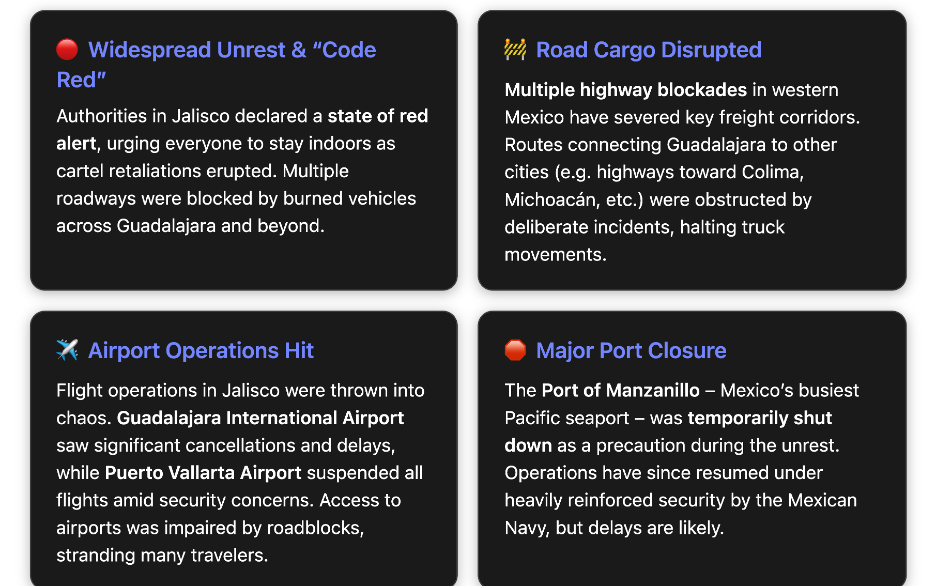
On February 22, 2026, a major federal security operation in Jalisco, Mexico (near Tapalpa) resulted in the death of cartel leader Nemesio “El Mencho” Oseguera, the notorious head of the Jalisco New Generation Cartel (CJNG). In the immediate aftermath, widespread violent reprisals erupted across parts of western Mexico. Armed groups carried out coordinated attacks, including roadblocks (narcobloqueos), vehicle burnings, and armed assaults in at least 14 states. The violence was concentrated in Jalisco – notably in the Guadalajara metropolitan area and Puerto Vallarta – and also affected neighboring Colima (Manzanillo) and other states (Michoacán, Guanajuato, Tamaulipas, Aguascalientes, and more). These incidents have serious implications for freight and logistics operations in the region.
Importantly, local authorities activated a “Code Red” in Jalisco, effectively a high-alert status, urging residents to shelter in place. As a result, public transportation was temporarily suspended in several areas. There are reports of casualties amid the clashes (including cartel members and possibly security personnel), and we extend our condolences to those affected. Our priority remains the safety of individuals and the security of our clients’ supply chains. The following is a summary of the key disruptions to logistics infrastructure and our recommendations for mitigating the impact on your freight operations.
The table below summarizes the primary disruptions as of Feb 22–23, 2026, by location and transport mode (road, air, sea):
| Location | Road Transport | Air Transport | Sea Port |
| Guadalajara (Jalisco) | Road blockades were reported on highways in and around Guadalajara, including major city arteries and routes to other states. - Vehicles (including trucks and buses) were hijacked and set ablaze at numerous points, effectively cutting off cargo movements on key corridors. Authorities halted public transit and warned civilians to avoid roads, indicating perilous conditions for freight transport. | Guadalajara Int’l Airport (GDL) saw flight disruptions: ~49 flights (25%) were cancelled and 42 (22%) delayed on Feb 22. - No attacks occurred inside the airport, but passenger panic ensued due to rumors and nearby violence. - Airport access roads were blocked by narcobloqueos, preventing cargo and passenger transit to the terminals. Flight operations were under military guard and continued at reduced capacity. | (Inland city – no seaport. The nearest port is Manzanillo.) |
| Manzanillo (Colima) | Highway blockades affected access routes between Jalisco and Colima. The main highway from Guadalajara towards Manzanillo port was impacted by violent incidents and vehicle burnings. - Cargo truck movements to/from the port were severely disrupted on Feb 22 due to these roadblocks and security checkpoints. | Playa de Oro Airport (ZLO) in Manzanillo (a small regional airport) experienced disruptions. Some flights were reportedly cancelled or diverted on Feb 22 as ground transport and security conditions deteriorated. (Note: This airport has limited cargo traffic.) |
Manzanillo Port operations were suspended temporarily on Feb 22 as a safety measure. The port authority (ASIPONA) announced a halt to vessel movements and closed port gates until further notice. - By later Feb 22, the Mexican Navy clarified that the port had reopened under extreme security: all terminals operating with reinforced protection (drones, patrols, controlled access). Expect vessel backlog and loading/unloading delays, as the initial closure and ongoing vigilance may slow normal throughput. |
| Puerto Vallarta (Jalisco) | Urban roadblocks and unrest were also reported in Puerto Vallarta. Armed groups set buses on fire in the city center and temporarily impeded highways (e.g. Libramiento Luis Donaldo Colosio). Local public transit was suspended for several hours, and road travel was hazardous, though this primarily impacts local distribution rather than long-haul freight. | Puerto Vallarta Int’l Airport (PVR) effectively shut down on Feb 22: 100% of flights were cancelled or rerouted that day29. (By 6:30 PM, 50% of scheduled flights – 61 flights – were confirmed cancelled30, with all remaining flights subsequently grounded.) - Several inbound flights to PVR were diverted to alternate airports31 32. Airlines (e.g. Air Canada, United) temporarily suspended services to PVR amid the turmoil |
(No commercial seaport in Puerto Vallarta; maritime freight uses Manzanillo or Lázaro Cárdenas.) |
Table Note: The situation remains fluid. Violence also flared in other areas (e.g., parts of Michoacán, Guanajuato, and border states like Tamaulipas), potentially affecting secondary routes and infrastructure. Authorities and the U.S. Embassy issued alerts, including for Nuevo León, Tamaulipas, Michoacán, and Guerrero, urging vigilance or shelter-in-place as needed. We advise monitoring these regions if your freight transits through them.
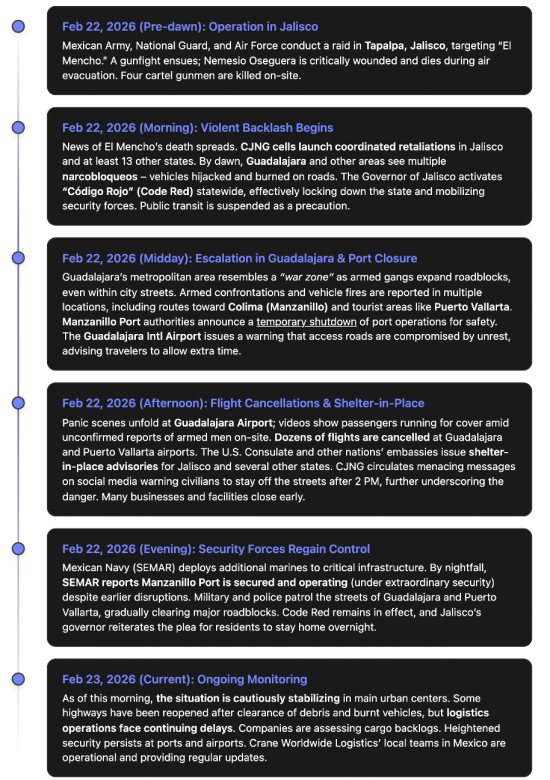
Manzanillo Port: After the temporary closure on Feb 22, Manzanillo Port has reopened with National Navy security reinforcement. Official statements confirm the port is now operating at Protection Level I (normal level) but with extraordinary protective measures (e.g., drone surveillance, maritime patrols, controlled entry). This port is critical for Mexican trade, handling the largest share of Pacific cargo, so any downtime has immediate supply chain effects. Expect delays and congestion as the port works through backlogs. Terminals are functioning, but it may take a few days for schedules to normalize. We advise anticipating possible vessel berthing delays and slower gate movements as authorities maintain checkpoints.
Guadalajara & Region Roadways: Many trucking routes to/from Guadalajara were impacted on Feb 22 by blockades. Key highways that saw incidents include the Guadalajara–Colima route, segments of the Guadalajara–Morelia (Michoacán) highway, and local ring roads and arterials around the city. As of Feb 23, most fires have been extinguished, and authorities are clearing debris. Freight traffic is resuming gradually on some corridors, but with delays. Security checkpoints may remain in place on highways as the military searches for cartel actors, which could slow truck transit. Therefore, over-the-road cargo moving through western Mexico should expect longer transit times and potential re-routing.
Air Cargo (Guadalajara Airport): Guadalajara International (GDL) is a major cargo airport (ranked 5th in Latin America). Freighter flights (cargo-only) were largely grounded on Feb 22 during the height of the unrest. By Feb 23, the airport had reopened under heavy security; passenger operations overnight were limited but are normalizing. Cargo flights are tentatively resuming. However, the airport’s cargo handling and trucking face challenges since access roads were blocked, and some staff could not reach the facility. Clients moving air freight via GDL should prepare for potential last-minute schedule changes and some handling delays as the backlog clears. Alternate airports (Mexico City, Querétaro, Monterrey) could be considered if urgency requires, but note some northern routes (e.g. via Nuevo León) may also see heightened security.
There is no major rail freight route into Guadalajara (freight is mainly truck-based in that corridor). As such, the primary concerns remain with road trucking, airports, and seaports. We are not aware of rail interruptions in the region. Warehouse operations in the Guadalajara area were effectively closed on Feb 22 during the Code Red. They may reopen on Feb 23/24 once safety is assured, but staffing could be an issue if curfews or advisories persist.
While the epicenter is in Jalisco/Colima, cartel-related unrest extended to some northern states. Notably, the U.S. Embassy alerts cited Tamaulipas and Nuevo León (which border Texas). There were unconfirmed reports of criminal roadblocks near Reynosa, Tamaulipas, on Feb 22. As a precaution, if you have cross-border trucking through Nuevo Laredo/Reynosa, stay in close contact with carriers for any delays. As of now, the main border ports

In light of these disruptions, Crane Worldwide Logistics recommends the following actions for our clients and partners to minimize the impact on your supply chains:
Lastly, please maintain close contact with your Crane Worldwide local representative. We are committed to ensuring our clients’ cargo moves as safely and efficiently as possible despite these challenges. We have enacted our business continuity plans in Mexico and globally to mitigate the impact on operations. The situation is dynamic, but with precautions and planning, we can manage through this disruption.
We will provide further updates as events unfold and when the situation normalizes. If you have any specific concerns about shipments, do not hesitate to reach out to your Crane Worldwide representative. The well-being of people is paramount – we hope for a swift restoration of safety in the affected communities – and we are here to support your logistics needs with that same priority in mind.
Let one of our client advocates build a solution that fits your logistics needs.

1500 Rankin Road
Houston, TX 77073
+1 888-870-2726
